One of the most frightening situations for parents travelling to Mainland China with a young child is a sudden high fever followed by seizures. When this happens in Shenzhen or another city in Guangdong, families may have to deal not only with the child's condition, but also unfamiliar medical procedures, payment arrangements, medical-record handover and possible transfer back to Hong Kong. The more urgent the situation, the more important it is to follow the correct order: obtain emergency treatment first, assess the child's condition, and only then decide whether cross-border transfer is appropriate.
One common cause of seizures during a fever in young children is a febrile seizure. A febrile seizure does not mean that the child has encephalitis or meningitis, and most brief episodes do not cause brain damage. However, if the child also has repeated vomiting, persistent lethargy, confusion, prolonged seizures or repeated episodes, prompt medical assessment is needed to rule out encephalitis, meningitis or other serious infections.
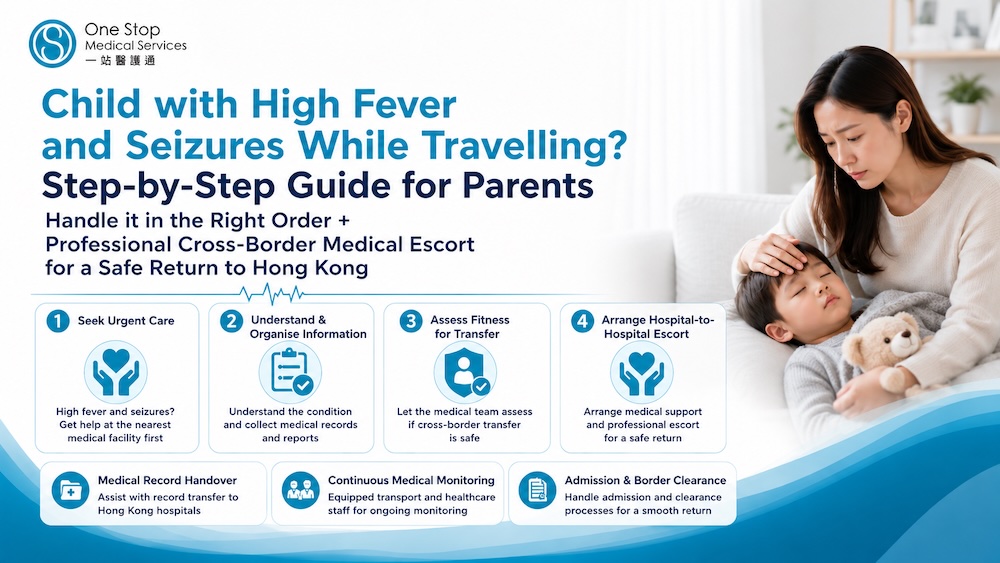
Step 1: Do Not Rush Back to Hong Kong - Seek Care at the Nearest Appropriate Medical Facility First
When a child develops seizures with a high fever, parents should first seek local emergency assistance. Mainland 120 services primarily provide pre-hospital emergency care and transport patients to an appropriate local medical facility according to the patient's condition, distance and medical needs. If the child is still convulsing, has impaired consciousness, unstable breathing or another emergency condition, immediate medical assessment and treatment should take priority over attempting to return to Hong Kong independently.
Cross-boundary direct ambulance arrangements are now available within the Guangdong-Hong Kong-Macao Greater Bay Area for certain eligible patients between designated hospitals. However, these transfers require assessment by medical teams on both sides, confirmation by the receiving hospital and coordination by the relevant authorities. They are not simply an extension of the ordinary 120 ambulance service and cannot be activated solely at a family's request for immediate direct transport to Hong Kong.
Step 2: Understand the Child's Condition and Organise Medical and Administrative Information
After the child receives initial treatment at a Mainland hospital, parents should ask the treating team about the current diagnosis, investigations already completed, medications given, whether vital signs are stable, and whether the doctor considers the child fit for long-distance or cross-border transfer. This information directly affects the type of transport that may be appropriate and the level of medical support needed during the journey.
Admission, investigations, medication and payment procedures vary between Mainland hospitals. Hong Kong families may also need to handle deposits, immediate payments, insurance claims and medical records. Nevertheless, patients who are critically ill should receive necessary emergency treatment first, and urgent care should not be delayed because of payment issues. Once the child's condition is initially stabilised, families can then organise receipts, imaging, investigation reports and discharge or transfer documents.
Step 3: If You Want to Continue Treatment in Hong Kong, First Assess Whether Transfer Is Safe
Many families hope to return to Hong Kong once the child's condition appears more stable. This is understandable, but being able to leave the hospital does not automatically mean that the child is fit to travel across the border in an ordinary vehicle. For a child who remains at risk of recurrent seizures, requires oxygen, has unstable vital signs or needs continuous medical monitoring, ordinary cross-border transport or wheelchair clearance at the boundary may result in interruptions in medical observation and support.
- Ordinary vehicles are generally not equipped with oxygen, vital-sign monitoring or emergency equipment tailored to the child's needs.
- Border clearance, vehicle changes and inspections may require the child to be moved several times, making care during the journey more difficult.
- If seizures recur, breathing worsens or consciousness declines during the journey, parents and ordinary drivers may not be able to provide the necessary professional medical response.
Step 4: When Medical Support Is Needed, Consider Hospital-to-Hospital Cross-Border Medical Escort
If the medical team considers the child suitable for cross-border transfer but ongoing monitoring or medical equipment is still required, a point-to-point hospital-to-hospital medical escort may be considered. The arrangement should be tailored to the child's actual condition, including the mode of transport, required medical equipment and appropriate healthcare personnel.
The medical escort team may also assist with organising and handing over treatment records from the Mainland and, where necessary, communicating with the treating team in the Mainland and the receiving healthcare institution in Hong Kong. Discharge, admission and cross-border arrangements can be coordinated in advance. Careful planning can reduce unnecessary movement during transfer and help maintain continuity of medical monitoring throughout the journey.
For parents, the key objective is not simply to cross the border as quickly as possible, but to complete the transfer with the appropriate level of medical support when the child's condition allows, so that ongoing treatment in Hong Kong can continue safely.
One Stop Medical Services provides professional point-to-point, seamless medical escort services. We can assist you or your family with complicated procedures and ensure that the patient receives appropriate medical monitoring and care throughout the journey back to Hong Kong.
For a free enquiry, please call or WhatsApp +852 9788 9115.