When a family member needs a cross-border hospital transfer, people often begin by searching for an ambulance to Mainland China, whether a patient can travel by high-speed rail, or whether an air medical transfer is needed.
The transport itself is important. But families who have actually arranged a transfer often discover that the hardest parts are the short “gaps” between different forms of transport.
How does the patient get from the ward to the station? How will boarding work? Where will the ambulance meet the patient after arrival? Who manages the stretcher transfer? Who hands the patient over to the receiving hospital?
For an independent traveller, these are ordinary connections. For a patient who must remain flat, needs oxygen, a ventilator or continuous monitoring, each one becomes a medical and logistical handover point.
Bed-to-Bed Care Is Really About Solving the Handover Problem
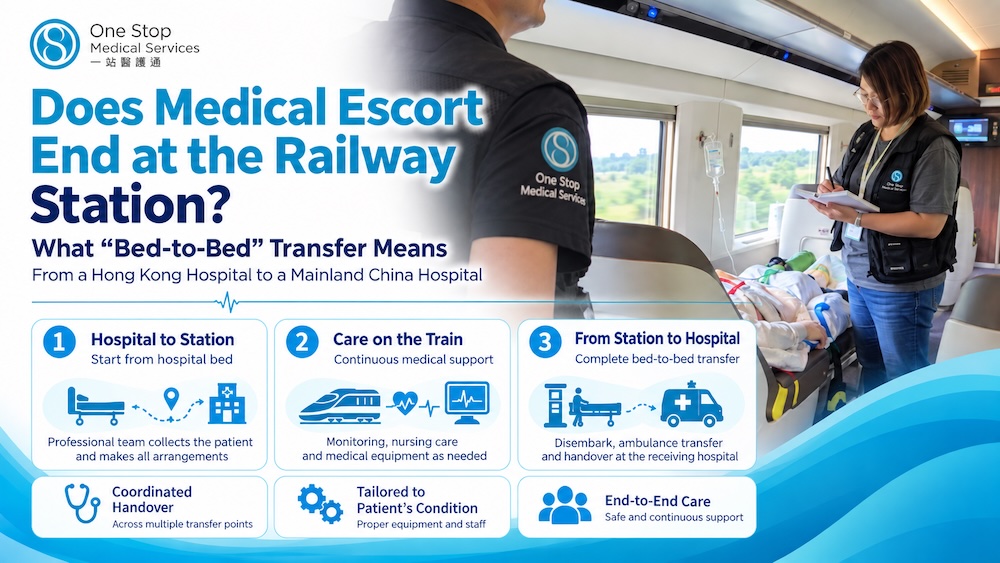
Bed-to-bed medical escort can be understood as taking responsibility from the time the patient leaves the original hospital bed until the patient reaches the destination bed or receiving medical facility and the handover is complete.
The important point is not that one specific type of vehicle must be used. It is that there should not be an unplanned gap between different stages of transport.
A single cross-border transfer may involve a hospital, ground vehicle, station, platform, high-speed train, destination station, ambulance and receiving hospital. If the family has to arrange each stage separately at the last minute, both stress and the risk of coordination problems increase.
The First Stage Looks Simple: Hospital Bed to Railway Station
It may sound like a straightforward ride from the hospital to the station.
But if the patient cannot sit independently and requires a stretcher, intravenous therapy, oxygen or other equipment, this is no longer ordinary transport.
The medical team needs to understand the patient's condition, required position, equipment and in-transit care, then work backwards from the train schedule to plan hospital collection and station preparation.
For early-morning trains, the escort team may begin work before sunrise.
The Most Underestimated Stage: Waiting Area to Train Carriage
An ordinary passenger can stand up and board when the train arrives. A bedbound patient cannot.
Boarding time is limited, so the positions of the patient, stretcher, equipment and staff need to be coordinated in advance.
In one actual case provided by the APHS team, personnel began preparing at the platform approximately 15 minutes before the train arrived. This timing describes that specific case rather than a universal station rule, but it demonstrates an important principle: boarding a medically dependent patient must be planned before the train reaches the platform.
During the Journey: The Vehicle Moves, but Care Cannot Stop
Once the patient is on the train, medical care is not simply paused until arrival.
Depending on the patient's needs, medical personnel may continue monitoring vital signs, administering intravenous therapy, repositioning, feeding support, and managing oxygen or ventilatory equipment.
Bed-to-bed care therefore connects not only the vehicles but also the patient's medical needs throughout the journey.
Another Common Gap: When the High-Speed Train Arrives
Time pressure appears again at the destination.
In this actual case, preparation began about 30 minutes before arrival, while the disembarkation and transfer process needed to be completed in approximately five to ten minutes.
These timings reflect the individual case, but the principle applies to any complex patient transfer: onward transport and receiving staff need to be organised before the train stops, not after the patient is already on the platform.
Why Is “An Ambulance Will Be Waiting” Sometimes Not Enough?
Because the ambulance may not be able to reach the exact location where the patient leaves the train.
In this case, the connecting ambulance could not enter the platform area. The patient first had to be moved onto a stretcher trolley, escorted out of the station, and only then transferred to the ambulance.
This is a classic transition gap. Booking the train and arranging an ambulance outside the station still leaves an important question: who will safely move the bedbound patient from the carriage to that ambulance?
Arrival at the Hospital Is Not Complete Until Handover
The final stage of bed-to-bed service is reaching the destination hospital and completing the handover to the receiving team.
Depending on the case, the escorting medical staff may need to explain the patient's condition during transport, care provided en route and any current concerns.
“Arrived” and “completed” are therefore not the same thing. The transfer is truly complete when the receiving healthcare team has taken over.
What Do Families Most Often Miss When Arranging Each Stage Separately?
- Booking transport without arranging how the patient will move from the ward to the station;
- Confirming that a stretcher exists but not who will transfer the patient and medical equipment;
- Calculating travel time but not waiting, boarding, disembarkation and transfer time;
- Arranging a destination ambulance without planning the transfer from the train carriage to that ambulance;
- Assuming that reaching the hospital entrance is the end without confirming receiving and handover arrangements.
These may seem like minor details for ordinary travellers, but for a patient requiring medical support, any unplanned gap can make the entire transfer significantly more difficult.
When Comparing Medical Escort Services, Ask Exactly Where the Service Begins and Ends
Families should not compare options only by vehicle cost, ticket price or one transport segment.
More useful questions are: Which hospital bed does the service start from? Who manages the patient and equipment during each transfer? Is onward transport already arranged? Does the team continue all the way to the receiving hospital and complete the handover?
When responsibility is clearly defined across the entire route, families have a much clearer understanding of what they still need to arrange themselves and are less likely to face last-minute transfer problems in an unfamiliar location.
One Stop Medical Services provides professional bed-to-bed medical escort services, helping patients and their families navigate complex transportation and administrative arrangements with ease. Our experienced medical team ensures that patients receive appropriate medical supervision, care and support throughout their journey.
For a free consultation, please call or WhatsApp us at +852 9788 9115.