When a family member needs to be transferred from Hong Kong to a hospital in Mainland China, should the journey be made by ambulance, high-speed rail or air?
It is natural to compare road or flight time first, but for a patient, “fastest” does not necessarily mean “most appropriate”. The real issue is whether safety, stability and continuity of care can be maintained throughout the entire journey.
Each transport method has different strengths and limitations. The patient's medical needs should be assessed first, and the route compared afterwards.
When Is an Ambulance Often Considered First?
The major advantage of an ambulance is direct point-to-point transport. A patient can be collected from a hospital or residence and taken to the destination with fewer intermediate transfers than rail or air.
If the patient requires more medical equipment, oxygen support or has a greater chance of needing intervention during the journey, road transport can offer more operational flexibility.
For very distant destinations, however, an all-road journey may take many hours. The patient may spend a long period inside the ambulance and the journey can also be affected by traffic and road conditions.
When Might High-Speed Rail Be Explored?
High-speed rail is better understood as another option for longer-distance ground medical transport rather than ordinary passenger travel.
For some inter-provincial or more distant cities, rail can reduce the amount of time spent travelling entirely by road. Services are relatively frequent and the ride is generally stable, so selected patients may be considered after assessment.
The key challenge is transfer coordination.
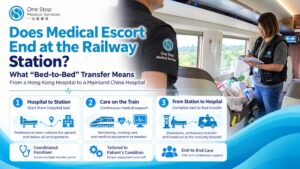
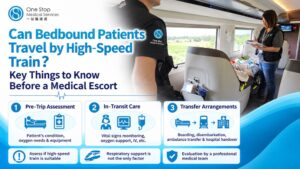
The patient must travel from hospital to station, board within a limited window, be positioned safely on the train, disembark within the station stop and then connect with onward medical transport.
If the patient has high oxygen requirements, is medically unstable or depends on equipment that cannot be safely used in the rail environment, high-speed rail may not be feasible.
Is Air Always Best for a Distant Destination?
Air transport has an obvious time advantage over very long distances, but medical transport cannot be assessed using flight time alone.
The patient still needs transport from the hospital to the airport, a safe boarding transfer, and onward medical transport from the arrival airport to the receiving hospital. The total bed-to-bed journey and every handover point must therefore be considered together.
The flight environment also involves cabin-pressure changes. Some patients who have undergone brain surgery or have certain chest or pulmonary conditions may require more careful assessment before air transport is considered.
A Simple Comparison: What Problem Does Each Mode Solve?
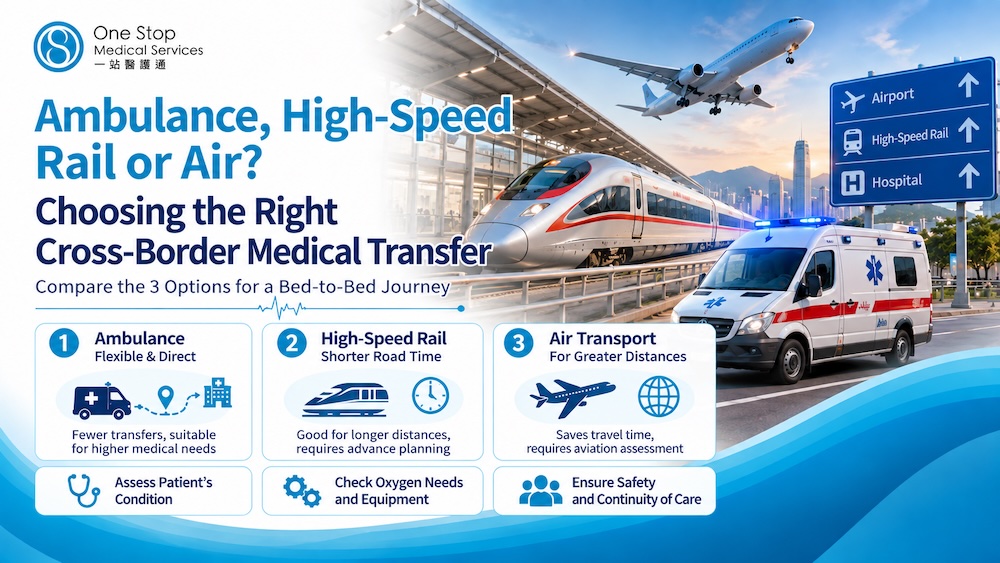
- Ambulance: High point-to-point flexibility with fewer transfers, but potentially long road travel for distant destinations.
- High-speed rail: May reduce road time on selected longer routes and offers a relatively stable ride, but requires precise coordination of boarding, disembarkation, oxygen and medical equipment.
- Air transport: Useful for much longer distances, but requires airport transfers and additional consideration of the flight environment.
Six Questions More Important Than Travel Time
Before choosing a transport method, families can ask the medical team:
- Is the patient currently stable enough for a long-distance transfer?
- How much oxygen is required, and can it be supplied reliably throughout the journey?
- Does the patient require a ventilator, monitoring equipment, intravenous therapy or other devices?
- Must the patient remain lying flat, and how much assistance is required at each transfer point?
- How far is the destination, and what is the realistic total journey time by road, rail or air?
- How many handovers are required between the departure hospital and the receiving hospital?
The Real Choice Is Not a Vehicle, but a Complete Transfer Route
Families often ask which mode is safest, but the answer only becomes meaningful when the patient's condition and the complete route are considered together.
The same patient may require a different solution when travelling to Shenzhen, Guangzhou, Changsha or a much more distant city. Likewise, two patients travelling to the same destination may need completely different transport arrangements because their oxygen, equipment and clinical needs differ.
Cross-border medical escort should therefore be planned from a bed-to-bed perspective: the departure hospital, transport vehicle, every intermediate transfer, the onward connection and the final handover at the receiving hospital are all part of one continuous medical journey.
Only then does a comparison between high-speed rail, ambulance and air transport become truly useful.
One Stop Medical Services provides professional bed-to-bed medical escort services, helping patients and their families coordinate complex transfer arrangements while maintaining appropriate medical supervision and care throughout the journey.
For a free consultation, please call or WhatsApp +852 9788 9115.