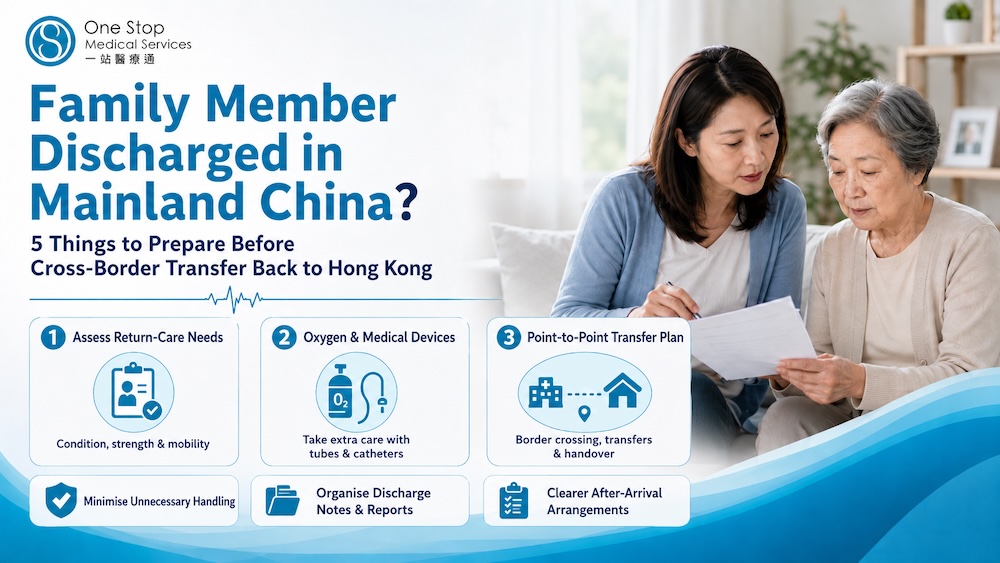
When a family member has completed treatment in a hospital in Mainland China and the doctor says that discharge is possible, it is usually welcome news for relatives in Hong Kong.
The next question, however, often comes immediately: “How do we bring them back to Hong Kong now?”
If the patient can walk independently and their energy and general condition are close to normal, the journey may be relatively straightforward. But if the patient has recently had pneumonia, a stroke, surgery or a serious infection, still needs oxygen, or has a feeding tube, urinary catheter or other medical device in place, the arrangement should not be treated as simply booking a cross-border car.
What needs to be planned is the complete transfer, from the hospital bed in Mainland China to the patient’s final destination in Hong Kong.
The first step after discharge approval: identify the level of care needed for the journey
Being “fit for discharge” generally means that the patient may no longer need to remain in the original hospital for inpatient treatment. It does not necessarily mean that no care or monitoring will be required while travelling.
Before arranging transport, families should therefore ask the treating doctor about the patient’s current condition, including the original reason for admission, the degree of recovery, whether vital signs are stable, current mobility and any symptoms that should be watched for during the journey.
This is particularly important for older people or patients with chronic conditions. Their illness may have improved considerably compared with the time of admission, while their strength and mobility may still be far below their usual level.
It is safer to understand the level of care required first and then choose the transport arrangement, rather than booking a vehicle first and only afterwards trying to work out what the patient needs.
Preparation 1: do not use the Google Maps driving time as the total journey time
Families often check the estimated driving time from Shenzhen or Guangzhou to Hong Kong and use that figure to decide whether the patient can tolerate the journey.
The real transfer time, however, is usually longer than the time spent driving.
From the moment the patient leaves the ward, the process may include transferring from a bed to a wheelchair or stretcher, using lifts, completing discharge procedures, boarding the vehicle, travelling to the boundary crossing, clearing immigration, waiting, and then travelling from the Hong Kong side to the final destination.
Traffic congestion, border queues and unexpected changes can make the total journey longer than expected.
The patient’s ability to tolerate transport should therefore be considered across the entire point-to-point journey, not only the navigation time between two locations.
Preparation 2: if oxygen is still needed, plan for the entire journey — not just the time in the vehicle
While a patient is receiving oxygen in hospital, the supply is continuous and readily available. Once the patient leaves the ward, however, the oxygen supply must move with the patient.
If healthcare professionals advise that oxygen is still required during the journey back to Hong Kong, families should confirm the relevant instructions and method of oxygen delivery before departure. The planning should include the time spent leaving the ward, waiting for transport, crossing the border, sitting in traffic and travelling to the final destination.
Medical transfer guidance generally calls for the expected oxygen requirement to be assessed before departure, with allowance for delays or increased demand.
The key point is not for families to calculate oxygen requirements on their own, but to avoid assuming that simply having an oxygen cylinder means that the whole issue has been solved.
Preparation 3: make a list of all medical devices that remain in place
Before discharge, families can make a simple checklist: does the patient still have a nasogastric feeding tube, urinary catheter, wound dressing or any other medical device that requires attention?
For each item, ask healthcare professionals about its purpose, routine care, what should be avoided while moving the patient, and what to do if something appears abnormal.
Many problems do not arise while a patient is lying still in bed. They may occur during bed-to-chair transfers, boarding or leaving a vehicle, changing sitting position or moving onto a stretcher.
Knowing how to avoid pulling, compressing or dislodging a device is therefore an important part of preparation for cross-border transport.
Family members should not remove or alter any tube or medicaldevice without instructions from healthcare professionals.
Preparation 4: plan every patient transfer in advance
A single journey back to Hong Kong may involve several physical transfers: from bed to wheelchair, wheelchair to vehicle, vehicle to stretcher, and possibly from the vehicle back to a hospital bed after arrival.
Families can consider several questions in advance: Can the patient stand independently? How long can they sit? Do they need to remain lying down? Do they have a fracture, surgical wound, pressure sore or significant pain? Is one helper enough, or are several people required? Are there stairs or narrow passages at the destination in Hong Kong?
For someone who has recently undergone surgery, has been bedbound for a long period or has significantly reduced mobility, the most difficult part of the journey may not be the time spent in the moving vehicle. It may be each individual transfer in and out.
Preparation 5: decide the Hong Kong destination and organise medical records before departure
It is better to decide where the patient will go after returning to Hong Kong before the journey begins.
If the patient is going directly home, is the required care already available? If they are returning to a residential care home, has the facility been informed of the latest condition? If further hospital treatment is required, have the receiving arrangements and medical information been prepared?
Before leaving the Mainland hospital, families can also organise the discharge summary, investigation reports, imaging records, current medication list and other relevant medical documents.
These records can help the healthcare professionals taking over in Hong Kong understand the treatment already provided and reduce the need for family members to reconstruct the entire medical history from memory.
When should a professional medical escort be considered?
Not every patient discharged from a Mainland hospital needs a medical escort.
If the patient is alert, has mobility close to their usual level, has no special medical devices requiring care and does not need monitoring during transport, travelling with family using appropriate ordinary transport may be sufficient.
On the other hand, if the patient remains very weak, cannot transfer independently, requires oxygen, has medical devices that need attention, or requires vital-sign monitoring and professional assistance during the journey, it is worth assessing whether a medical escort is appropriate before departure.
The value of medical escort is not simply the availability of a vehicle. It is the ability to connect the patient’s clinical needs, transfer method, equipment, escort personnel and Hong Kong destination into one coordinated plan.
Treat the return to Hong Kong as a medical transfer plan, not simply a car journey
When a family member is cleared for discharge, it is natural to want to bring them back to Hong Kong as soon as possible.
For a patient who remains physically weak or has ongoing care needs, however, planning should not begin with “finding a car”. It should begin with understanding what the patient currently needs.
Once the condition and mobility have been clarified, the family can then plan oxygen, medical devices, transfer arrangements, documents and the final destination in Hong Kong. This makes the entire journey clearer and more manageable.
Every patient is different. If there is any uncertainty about whether a patient is suitable for prolonged or cross-border transport, the treating healthcare team should be consulted about the patient’s clinical condition and relevant precautions before travel.
One Stop Medical Services provides professional point-to-point seamless medical escort services. We can assist you or your family with complex arrangements and help ensure that appropriate medical monitoring and care are provided throughout the journey back to Hong Kong.
For enquiries, please call or WhatsApp +852 9788 9115 for a free consultation.