Retirement brings more opportunities to travel. Getting older does not automatically mean giving up holidays. What deserves attention in advance is how existing health conditions, regular medication and medical information will be managed if something unexpected happens.
For people taking anticoagulants, diabetes medication or other long-term prescriptions, a clear one-page medical summary may be more useful in an emergency than a large bundle of unorganised test reports.
If a patient cannot speak, how much do companions know?
After retirement, Mr A enjoys travelling to mainland China with friends. He has cardiovascular disease and takes a long-term anticoagulant, commonly called a blood thinner. He previously underwent hip surgery and a fixation procedure for a lower-leg fracture.
Imagine that he falls and loses consciousness while visiting Shangri-La. The local medical team would prioritise emergency treatment while gathering details about his chronic conditions, prescriptions and allergies. If his companions cannot identify medicines or doses and are unable to reach his family quickly, additional verification may be needed.
The point of this example is not to claim that missing records directly cause gastrointestinal bleeding or acute kidney failure. It is that well-organised information can support clinical assessment and continuity of care.
Essential 1: A personal medical summary that is easy to read
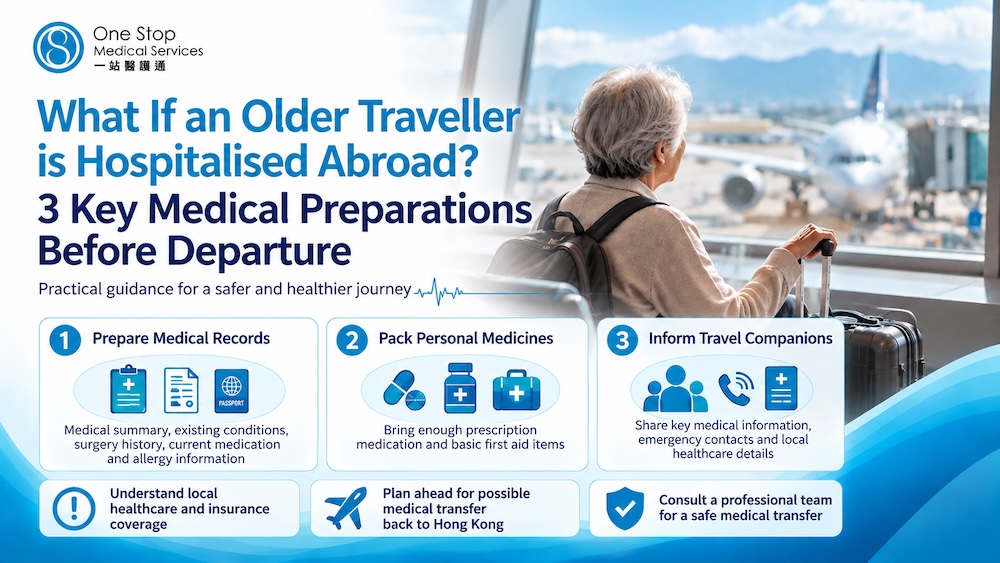
Before departure, ask the treating clinician whether the planned trip is suitable and whether a concise medical summary would be useful. For travellers with chronic disease, long-term prescriptions or previous major surgery, the summary may include:
- Important diagnoses, past operations and implants, such as a joint replacement or fracture-fixation hardware.
- Generic medication names, doses and timing, particularly treatments such as anticoagulants that require special attention.
- Known drug allergies and serious adverse reactions, including what happened during a previous reaction where known.
- Medical-device needs, the treating clinician’s details and emergency contacts.
Keep a paper copy and an offline phone copy. For international trips, consider a version in English or a language commonly used at the destination. Protect private health information rather than sharing complete records in public group chats.
Essential 2: Medicines selected for the individual traveller
A travel health kit does not mean packing every over-the-counter medicine available. Start with an adequate supply of prescribed daily medicines in original labelled packaging, and keep prescriptions or a medicine list accessible in hand luggage. Ask a doctor or pharmacist about an appropriate extra supply in case of delays.
Items for fever, stomach symptoms or minor wound care should be chosen with regard to the destination, existing conditions and potential medication interactions. People taking blood thinners should not independently add painkillers or alter doses. Check destination rules, as some medicines face import restrictions.
Essential 3: Make sure one trusted companion knows the plan
In addition to disclosing serious known allergies, tell a trusted companion whom to contact, where important documents are kept, whether the traveller needs mobility or feeding assistance, and how to reach the travel insurer’s emergency support line. These details can make hospital-to-family communication less confusing.
Printable travel medical information checklist
- Name, emergency contact and telephone number
- Main diagnoses, important operations, implants and special care needs
- Regular medicines: names, doses and times
- Known medication or food allergies and previous reactions
- Treating clinician’s contact details and essential test reports
- Travel insurance policy details and emergency assistance number
If someone becomes unconscious, is injured or becomes seriously unwell, seek local emergency medical help immediately. Do not delay urgent treatment while looking for records. The purpose of the information pack is to help clinicians understand the patient’s background and support later care and handovers.
Keep information continuous from overseas treatment to care at home
If a traveller is admitted to hospital abroad, relatives can ask the treating facility for a discharge or clinical summary, medication record, test findings and any recommendation concerning onward care. If a return to Hong Kong for treatment is being considered, medical fitness for transfer and acceptance by the receiving provider should be assessed first.
ONE STOP MEDICAL SERVICES encourages travellers with chronic conditions to arrange a pre-travel health review, organise medical documents and check their medicines. A simple, accurate travel medical essentials pack can improve preparedness and make handovers clearer when additional care is needed.
One Stop Medical Services provides professional point-to-point, seamless medical escort services. We can assist you or your family with complicated procedures and ensure that the patient receives appropriate medical monitoring and care throughout the journey back to Hong Kong.
For a free enquiry, please call or WhatsApp +852 9788 9115.