When families plan a cross-border hospital transfer, they often focus on travel time, comfort on the train and whether medical staff will be present during the journey.
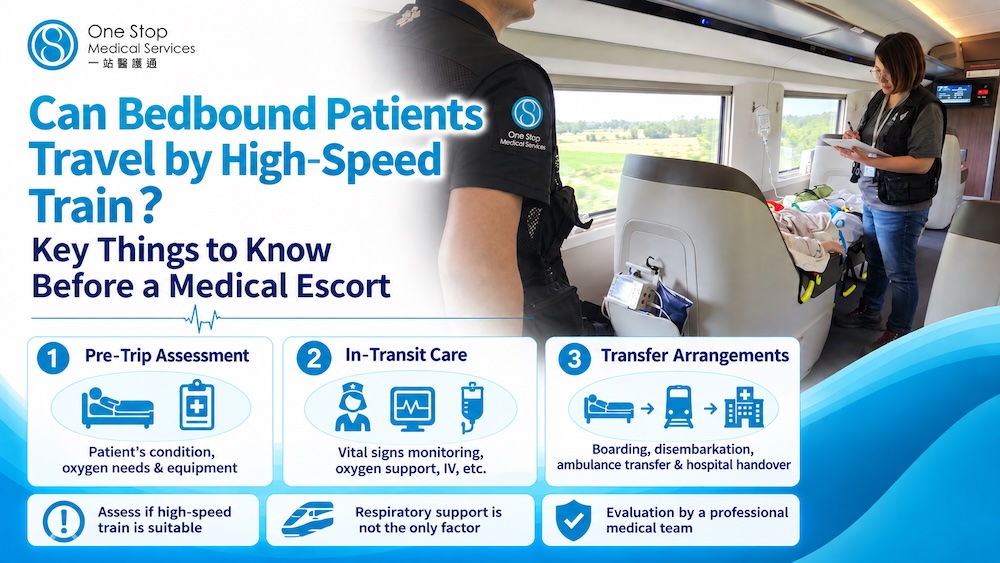
For a bedbound patient or someone who depends on medical equipment, however, some of the most easily overlooked risks occur during transfer points: moving from bed to stretcher, from the waiting area onto the train, from the carriage to the platform, and from the station to the connecting ambulance.
Each transfer may last only a few minutes, but it can involve the patient’s position, tubes, medical equipment, multiple staff members and strict timing.
Families should therefore understand not only how the patient will be cared for on the train, but also how boarding and disembarkation will actually be managed.
Why Does Preparation Need to Begin Before Boarding?
High-speed rail follows fixed schedules and boarding windows. A medical escort team cannot assume that unlimited extra time will be available for an individual patient.
In one practical escort arrangement, after the patient had been prepared in the waiting area, relevant personnel moved to the platform approximately 15 minutes before the train arrived to complete final coordination.
The purpose was to use the actual boarding window for patient transfer rather than for last-minute equipment organisation, staff allocation or route confirmation.
For a bedbound patient, early preparation is not merely convenient. It is an important part of reducing confusion during the transfer.
What Can Go Wrong When the Patient Is Being Moved?
When a patient is transferred from one position to another, the medical team may need to manage several issues at the same time, including:
- Whether the patient must remain flat or maintain a specific position;
- Whether intravenous lines, tubes or monitoring equipment could be pulled or displaced;
- Whether the stretcher and equipment can pass safely through the planned route;
- Who is responsible for the patient, the equipment and the receiving coordination;
- Whether the patient and equipment can be stabilised promptly once inside the carriage.
These details may appear minor, but if they are only addressed at the last moment, the transfer can quickly become rushed.
Why Start Preparing to Disembark About 30 Minutes Before Arrival?
Disembarkation does not begin only after the train has stopped.
In this particular case, the team was notified and began preparing approximately 30 minutes before reaching the destination, while receiving personnel were also positioned at the platform in advance.
The medical team needed to organise the patient, equipment and medical supplies and confirm the order of movement before arrival.
This advance preparation is one of the reasons a time-sensitive transfer can proceed in an orderly way.
Why a 5-to-10-Minute Transfer Cannot Depend on Simply “Moving Faster”
For this particular case, the relevant disembarkation and transfer procedures needed to be completed within approximately five to ten minutes.
Simply telling everyone to move faster can create more confusion. The important factor is that each person already knows their role.
One person may control the stretcher, another manage the equipment, another monitor the patient, while others coordinate the platform and receiving arrangements.
When responsibilities are clear in advance, a short transfer window can be managed in an organised manner rather than becoming a last-minute rush.
Leaving the Carriage Does Not Mean the Patient Is Already in the Ambulance
Another point families may overlook is that an ambulance may not be able to drive directly to the high-speed rail platform.
In this case, after leaving the train, the patient first had to be transferred onto a stretcher trolley and escorted out of the station before meeting the pre-arranged ambulance.
The journey from platform to station exit therefore still requires planning for medical equipment, monitoring and staff support.
If a family has arranged only the train ticket and an ambulance outside the station, but not the transfer between the two, the hospital-transfer plan is still incomplete.
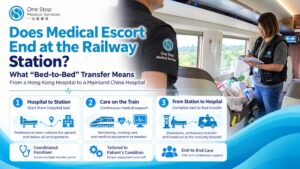
Bed-to-Bed Means Someone Is Responsible Across Every Transfer Point
A complete medical escort does not end when the patient reaches the railway station, nor does it end at the destination station.
The team needs to connect the departure from the Hong Kong hospital, train boarding, in-transit care, destination disembarkation, connecting ambulance and receiving-hospital handover into one continuous journey.
Families do not need to memorise every technical detail. What matters is knowing who is responsible for each stage and whether there is any gap where no one is clearly responsible for the patient.
That is the practical purpose of a bed-to-bed medical escort service.
Questions Families Can Ask When Reviewing a High-Speed Rail Transfer Plan
- Where will the patient be prepared before boarding?
- How will the stretcher and medical equipment enter the carriage?
- How long before arrival will preparation for disembarkation begin?
- Will receiving personnel already be waiting at the destination platform?
- Where can the ambulance wait, and who is responsible for the transfer between the platform and ambulance?
- Who will continue with the patient to the receiving hospital and complete the handover?
When these questions have clear answers, high-speed rail becomes one properly connected part of a complete medical transfer rather than simply an isolated train ticket.
One Stop Medical Services provides professional point-to-point, seamless medical escort services. We can assist you or your family with complicated procedures and ensure that the patient receives appropriate medical monitoring and care throughout the journey back to Hong Kong.
For a free enquiry, please call or WhatsApp +852 9788 9115.