When a family member needs to be transferred from Hong Kong to a hospital in Mainland China, an ambulance may be the first transport option that comes to mind.
For a more distant destination, however, could high-speed rail also be considered?
There is no simple yes-or-no answer.
The patient's condition, need to remain lying down, oxygen requirements, medical equipment, destination and practical boarding arrangements all affect whether rail transport is appropriate.
A recent hospital-to-hospital high-speed rail medical escort provides a useful example of what actually needs to happen behind the scenes.
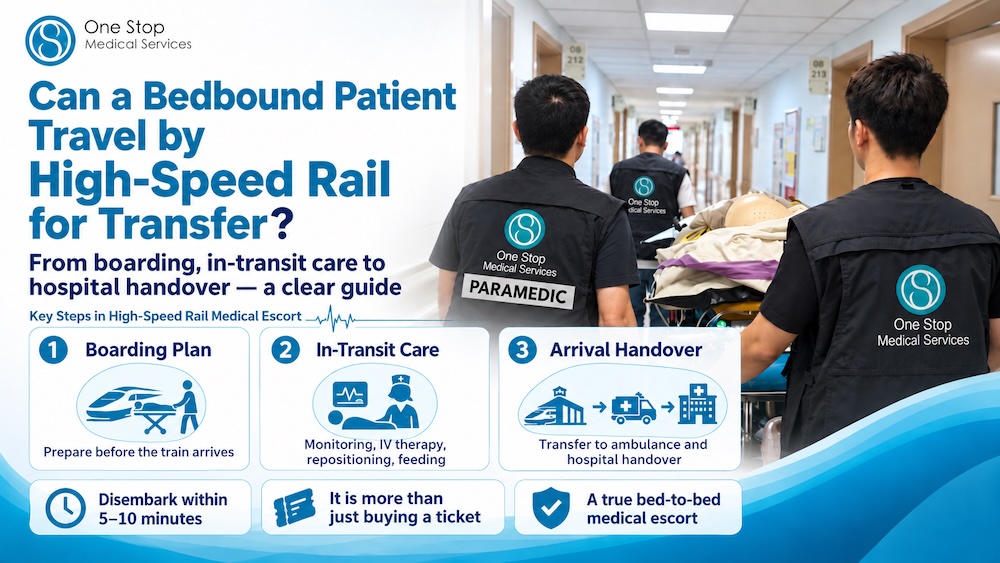
Question 1: How Does a Bedbound Patient Board a High-Speed Train?
An ordinary passenger can simply walk into the carriage.
A bedbound patient cannot.
Because the boarding window for high-speed rail is limited, the medical team must be ready before the train arrives.
In this particular case, the patient was first prepared in the waiting area. Approximately 15 minutes before the train arrived, personnel began preparing for boarding at the platform.
The questions that need to be considered go far beyond whether a stretcher is available.
- Does the patient need to remain flat?
- Which medical devices must travel with the patient?
- Who will manage the patient's physical transfer?
- Who will handle the equipment?
- Where and how will the patient be positioned after boarding?
All of these details need to be planned before the train arrives.
Question 2: What Happens to Medical Care During the Journey?
For an ordinary passenger, several hours on a train may simply mean sitting back and resting.
For a patient under medical escort, care may need to continue throughout the journey.
During this transfer, the medical team remained with the patient and continued the required care according to the patient's condition. This included measures such as monitoring vital signs, intravenous therapy, repositioning and feeding assistance.
The purpose of medical escort is therefore not simply to move a patient onto a train.
It is to maintain the required level of care from the hospital, through the transport journey, and until the patient reaches the receiving medical facility.
Question 3: What Happens When the Train Stops for Only a Short Time?
Disembarkation can be even more time-sensitive than boarding.
In this case, preparations began approximately 30 minutes before the train reached its destination.
Receiving personnel were also positioned at the platform in advance.
Because the train's station stop was limited, the patient and equipment had to be moved within a short period.
For this particular journey, the relevant transfer procedures needed to be completed within approximately five to ten minutes.
This means the team cannot wait until the train stops before deciding what to do next.
Disembarkation is a coordinated process that starts before arrival.
Question 4: Does the Patient Transfer Directly from the Train to an Ambulance?
Not necessarily.
Station arrangements differ.
In this particular case, the connecting ambulance could not drive directly beside the train platform.
The patient therefore first had to be transferred onto a stretcher trolley, escorted out of the station and then connected with the pre-arranged ambulance.
The medical escort team continued travelling with the patient to the receiving hospital in Mainland China.
The journey was only complete after the patient arrived at the destination hospital and a formal medical handover had been completed.
This is one of the main differences between ordinary transport and a genuine bed-to-bed medical escort service.
Which Patients May Be Considered for High-Speed Rail Transport?
Some patients who need to remain lying down, require post-operative observation or need ongoing medical monitoring during transport may be considered for high-speed rail medical escort if their condition is sufficiently stable and the journey is deemed appropriate following professional assessment.
Patients who require ventilatory support may also need to be individually assessed according to their oxygen requirements, equipment needs and overall medical condition.
There is therefore no universal answer to the question:
“Can an ICU patient travel by high-speed rail?”
Instead, the medical team needs to assess factors such as:
- whether the patient is stable enough for transfer;
- whether oxygen needs can be maintained throughout the journey;
- whether required medical equipment is compatible with the rail environment;
- what level of medical support is required in transit;
- and whether boarding, disembarkation and onward transfer can be safely arranged.
Patients Requiring Oxygen Need Additional Assessment
Oxygen delivery and medical equipment are important practical considerations in high-speed rail medical transport.
If a patient requires a relatively high level of oxygen support, or if the necessary equipment cannot be safely used throughout the rail journey, high-speed rail may not be an appropriate option.
The medical team therefore needs to consider the patient's oxygen requirement, equipment capacity and total journey time in advance.
Families should not make a decision simply on the basis that the patient is currently receiving oxygen.
A full medical and logistical assessment is required.
What Are the Potential Advantages of High-Speed Rail?
For some longer-distance routes, high-speed rail can reduce the amount of time a patient would otherwise spend travelling entirely by road ambulance.
The rail network also reaches a wide range of destinations, services are relatively frequent, and train travel is generally stable.
Compared with air transport, high-speed rail does not involve the changes in cabin pressure associated with flying.
For patients whose medical condition requires additional consideration before air travel, rail transport may therefore be one of several options considered by the medical team.
However, this does not mean high-speed rail is always better than an ambulance, or that a patient who is unsuitable for air travel should automatically travel by train.
The most appropriate transport method depends on the patient's condition, travel distance, timing, destination, equipment requirements and required medical staffing.
Families Need to Plan the Entire Journey, Not Just the Train Ride
One of the most easily overlooked parts of a medical transfer is the handover between different stages of the journey.
- How will the patient leave the Hong Kong hospital?
- How will the patient enter the railway station?
- How will boarding be arranged?
- Who will provide care during the journey?
- How will the patient leave the train within the limited station stop?
- Where will the connecting ambulance wait?
- Who will receive the patient at the destination hospital?
If even one stage is not properly coordinated, the overall transfer can be affected.
For a patient requiring cross-border hospital transfer, the real task is therefore not simply arranging a high-speed rail journey.
It is organising a continuous medical escort from the first hospital all the way to the receiving hospital.
One Stop Medical Services provides professional point-to-point, seamless medical escort services. We can assist you or your family with complicated procedures and ensure that the patient receives appropriate medical monitoring and care throughout the journey back to Hong Kong.
For a free enquiry, please call or WhatsApp +852 9788 9115.